
Biomechanics Short Lecture
The Biomechatronics of Walking
This is an introduction to nature’s design principles and what they mean for robotics.
For traveling long distances on foot, humans are the very best in the animal kingdom—surpassing even horses, cheetahs, and ostriches. This has made us the ideal species to travel across the globe, such as in humanity’s adventure to North America across the frozen Bering Strait $\approx$20,000 years ago.
This capability for two-legged endurance has served us well in travel as much as finding food. A cavemen’s best friend for securing a meal was persistence hunting. No spears or tools required: simply run after a gazelle for 4 hours, and it will drop from exhaustion, leaving you a free meal.
Extremely efficient walking is a subtle superpower of the human race that is only made possible by our underlying dynamics. By grasping this, we can engineer this superpower for our own creations (at the risk of our hubris).
The Human as a Dynamical System
Walking is, very simply, a leg pivoting around your grounded foot, or, in a physicist’s eyes, a pendulum rotating about a point on the ground. We call this system an inverted pendulum since most pendulums (like metronomes) are hanging, not being supported.
If you start moving forwards, your body, which is attached to the pendulum, will trace an arc. At some point, you move to the other leg, and the arc begins once more.
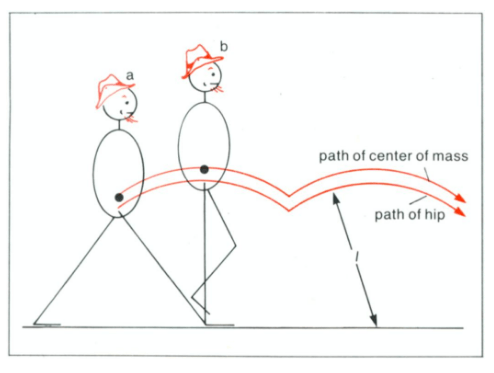
This model brings us to some fun observations! Since walking is basically a safer version of falling forwards, the maximum acceleration we can get is the gravitational acceleration $g=9.81:\text{m}/\text{s}^2=32.2:\text{ft}/\text{s}^2$. You might recall from physics class that this kind of circular acceleration is $\frac{v^2}{r}$ (here $r$ is the length of your leg), so your circular acceleration when walking will always be less than or equal to $g$. Thus,
$$ \frac{v^2}{r}\leq g\implies v\leq\sqrt{rg} $$
Conclusions:
- There is a physical theoretical limit to how fast we can walk. This is why we have to run.
- Those of us that are vertically challenged (low $r$) are even more limited. Sorry!
This model is, however, simplified. In reality, humans achieve much of their energy efficiency due to